Sunday, January 22, 2012

Extremely Apologetic and Unbelievably Genuine

Two high-profile apologies caught my attention this weekend that I thought I’d write about today.  The first was Mark Wahlberg’s apology for saying in an interview that if he and his family had been aboard one of the planes hijacked on 9/11 – as he was scheduled to be – things would have happened differently.  The second was also 9/11-related when Warner Brothers apologized for running trailers for their new movie, “Unbelievably Loud and Incredibly Close,” near the site of the attacks.  (The trailer includes images of Sandra Bullock watching the Twin Towers burn.)

I believe both apologies were unnecessary and I planned on beginning with a snarky comment about how it had been “X” days since we’ve had a good public apology and that we were simply due.  I did a quick internet search for “issued an apology” and was surprised to find that zero days had elapsed since the last apology.

We’re up to our necks in apologies – more than 1,700 news stories about apologies in the past month.  We’re either too thin-skinned for our own good, or we put too many microphones in front of too many dolts.

Here were some of the Apology Highlights for the month of January, (you can follow the links to read more about each story, but do come back here to see if I can tie it all up in a bow at the end):

Vancouver police have apologized for mistakenly arresting (and roughing up) a man in his front yard.  The police were chasing a different man who was seen running from a nearby bank.  Apparently the cops couldn’t catch him, what with all the running, so they decided to literally tackle the easier target – some guy standing still.  While officers were repeatedly lowering the innocent man’s face to the ground, a fleet-footed member of the force did manage to catch up with the Bank Runner.  Interestingly enough, he was released because simply running is apparently not a crime.  He hadn’t robbed the bank, rather he was just late for something.
An Argentine daily newspaper, Pagina/12, apologized for a cartoon depicting Hitler running a concentration camp dance party at which he confided in the DJ that when the Jews relax and dance, the soap he makes from their corpses is better.  Yah.
Katy Perry’s father, an evangelical minister, apologized for some unoriginal anti-Semitic remarks he made that seemed to be geared towards bringing Mel Gibson into his flock.
And in case you think only anti-Semites say things worthy of apology, the editor, owner, and publisher of a paper called “The Atlanta Jewish Times” issued an apology for writing in an editorial that he thinks Israel should assassinate President Obama to preserve Israel’s future.  Also perhaps he should look into whether or not doctors can now reverse full frontal lobotomies.
Fashion house Dolce & Gabbana has apologized twice this month.  First for racist actions they did not take, and then a second time for those actions.  Uh-huh.  At issue are allegations that the D&G store in Hong Kong allows Chinese and other tourists to take pictures in front of the store, but does not allow native Hong Kongers to do so.  What I loved about both these apologies is that they convey the sentiments of a certain Cee-Lo Green song. 
From the first apology: “…our company has not taken part in any action aimed at offending the Hong Kong public.”  And from the second: “We understand that the events which unfolded in front of [our store] have offended the citizens of Hong Kong, and for this we are truly sorry and we apologise.”  Well done.
CBS Sports apologized for announcing that Joe Paterno had died.  That’s one of those cases where they meant to SAVE DRAFT but instead hit PUBLISH.  (I hate when that happens – and now look, between first draft of this column and publication, he has actually passed away.)
A Cardinal in Chicago apologized for comparing gays and lesbians to the Ku Klux Klan.  This too seems like a reasonable apology, though after reading his original statement, the first non-apology, and then the actual apology, I’m not 100% certain he was making that comparison.  I think he just might be really bad at making analogies.
“Pizza” chain Papa John’s apologized for a customer receiving a receipt that identified her with a racial slur.  The individual franchise offered a silly and weak apology, then HQ stepped in and did it right with an unequivocal apology and instructions to fire the employee responsible.  Good for them.  And good for them also sticking to their guns and not apologizing for the pizza itself.
There were other apologies that, like these listed above, were called for.  But what I really wanted to write about was the unnecessary apologies.  I put the Wahlberg and Warner Brothers apologies in that category.  They are apologies motivated by fear of offending, or regret at having offended people who generally have too much time on their thin-skinned hands.
The Warner Brothers apology and promise to pull the ads from public spaces close to the New York site of the 9/11 attacks was either part of a well-thought out publicity effort or much ado about nothing.
I suspect the film, like the book upon which it is based, deals with the tragedy and loss around 9/11 in a meaningful and respectful way.  I say “suspect” because I haven’t read the book and doubt I’ll see the movie.  Why?  I don’t feel the need to relive the tragedies; however, I also don’t begrudge others their right to do just that.  Tragedies just aren’t really my thing, not if I can help it.  And if it involves the premature death of a parent with young children, or children themselves, yeah, I’ll take a pass on that.
If the Warner Brothers trailers were for the film adaptation of “9/11 The Musical: Let’s Roll…and Rock” I could see that being upsetting – not just to people who lived through the attacks first hand, but for most.  But they weren’t.  They were somber, serious trailers for a somber, serious film. 
Pulling the trailers from locations in lower Manhattan is silly.  If the images upset people, they’ll upset them everywhere.  Should the marketing department track the location and movement of everyone impacted by 9/11 to ensure they don’t run the ads near these people?  In a way, the implication is insulting to the rest of us: people who live and work in lower Manhattan feel real pain, the rest of us are pikers.
The studio overreacted.  Or they played it perfectly, earning some extra ink by using traumatized victims to help build buzz for the film.  I hope that wasn’t the plan.
Mark Wahlberg, a proud family man with a history of real life violence, (as a youth, he was banned from the South Boston Boys & Girls Club he used to attend and now financially supports), said, “If I was on that [9/11] plane with my kids, it wouldn't have went down like it did -- there would have been a lot of blood in that first-class cabin and then me saying, 'OK, we're going to land somewhere safely, don't worry.'"
He was saying that if the lives of his children were being threatened, he would be compelled to act, putting his fists where his mouth is.  Now the blood all over First Class may well have ended up being his, and nothing would have changed from a historical perspective, but why can’t he express those thoughts? 
His apology, which, by the way, was actually top notch and classy, gives us a clue.  He said, “To suggest I would have done anything differently than the passengers on that plane was irresponsible. To speculate about such a situation is ridiculous to begin with…I deeply apologize to the families of the victims that my answer came off as insensitive, it was certainly not my intention."
The apology implies that some were offended because they thought Wahlberg was saying he is braver and loves his children more than the passengers on the plane.  Really?  Do they genuinely think Wahlberg thinks this?  I mean, really and truly.   I don’t.  And guess what, it doesn’t matter if he does.  He’s just a person, entitled to an opinion.  An opinion I don’t think he was expressing, and even if he was, it says more about him than about the 9/11 victims.
And guess what?  I’ve had similar thoughts, (without the First Class bit).  And I’ll bet we’re not alone. 
We’ll never know for sure everything that happened on the planes that were flown into the Twin Towers; for all we know, some passengers, like those on United 93, did rise up against the hijackers and were killed for their efforts to get back to their families.
I simply don’t believe it’s disrespectful to try to imagine how you would have reacted if you had been placed in that terrible situation.  Asking yourself “what would I do?” is what makes us human.  And I think it’s a question every American asked after the 9/11 attacks.  It doesn’t lessen the memory of those who died, if anything, our reflecting on the horror they faced keeps their memory and courage alive.
Wahlberg did not need to apologize for what he said.  His involvement in “The Happening,” however, is another matter.
The reality is, I think there’s too much apologizing going on.  Public figures and companies are often quick to apologize for things that will hurt their image or sales, and they usually don’t really mean them.  Not one contrite word.
For example, Mel Gibson’s apologies, (like those of Katy Perry’s father) are completely hollow.  They are not sorry for what they said.  They are sorry we heard them.  And they absolutely still hold those beliefs, and they always will.  They can, as Susan Ross (Heidi Swedberg) from “Seinfeld” said, “stuff those ‘sorrys’ in a sack.”
This endless succession of publicly expedient apologies that the politically correct and easily-outraged demand, and the accompanying hand-wringing, tersely-worded, and legally-non committal statements, and in some cases the shedding of gallons of crocodile tears, devalue the genuine apologies.  Apologies like Mr. Wahlberg’s.
Before we demand apologies and threaten boycotts we should ask ourselves two key questions.  First, does this situation truly merit a public flogging and apology or am I just a little grumpy today?  And second, will the apology matter or will I not believe it?  If the answers are “no,” we should probably just put the incident behind us and get on with our lives.

Wednesday, January 18, 2012

Is It Me, Or Is Everyone A Little Too Easy to Please?

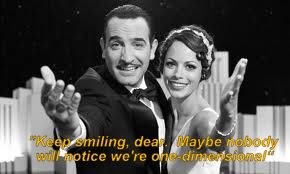
The best reviewed film of 2011 is "The Artist," a French movie about Hollywood during the turnover from silent films to talkies. The film itself is mostly silent, (more on what that means in a moment). The film has been wowing audiences at film festivals and picking up awards all over the globe. It was nominated for, but did not win, the Palm d'Or at Cannes, but it did just win three Golden Globes, including Best Film, Musical or Comedy. Critics, (97% fawning according to Rotten Tomatoes) are using words like "joyful," "mesmerizing," and "stunning." I'd use words like "fun," "interesting," and "adequate."

Don't get me wrong, I enjoyed the film. Not as much as when it was called "Singing in the Rain," but I did enjoy it.


The star, Frenchman Jean Dujardin, is even more handsome and charming than the stars upon whom he is based; he's Douglas Fairbanks, Maurice Chevalier, Gene Kelly, and Rudolph Valentino all rolled into one, and he carries the film. I think it's his magnetic smile, hugely expressive face, and intoxicating performance that has so fooled audiences into thinking they're seeing a complete film.

Dujardin deserves his Golden Globe and the other awards he's been winning, and he'll deserve his Oscar nomination that is going to be forthcoming. He might even deserve to win. And I suspect he will.

But while Dujardin's performance is electric, the rest of the film is somewhat incomplete.

I have to be careful here – I already loathed another film that people have been falling all over themselves this season calling it an instant classic. I also can't use the Emperor's New Clothes analogy – I used it on Scorsese's "Hugo." Actually, that kind of criticism is too harsh here. "Hugo" made me violently angry, "The Artist" just disappointed me – a victim of its own critical success – being overhyped the way it has been.

The fact that the film is almost completely silent is an almost completely clever homage to the films of the day. What does everyone mean "mostly silent?" Well, there are two brief sequences in the film where we do hear sound, and director Michel Hazanavicius has chosen them well. (Sorry, I don't do spoilers, even in films I'm not crazy about. You'll have to take my word for it that the sequences work and are fun.)

Gosh that's a great idea – making a silent movie about making silent movies but using a little bit of sound. Where have I seen that before? Oh right, Mel Brooks' "Silent Movie." While several reviewers have mentioned "Singing in the Rain," nobody has given a nod to Brooks' brilliant effort.

One of the things reviewers seem to like most about the film is that it is an homage to silent films, and being silent is a part of that. Well, here's the problem. Most silent films don't hold up today. The characters are one-dimensional, the stories are so simple you could write out the plot on just a few title cards, and the dramatic tension is usually limited to a woman being tied to railway tracks. The films are, in a word, hokey.

I mean no disrespect to the films of the day. They were experimental and ground-breaking; they paved the way for all the great films that have come since, and the films yet to be. We couldn't have the medium today without the work they did then, but that doesn't mean what they did then, works today.

It's kind of like how medicine has evolved over the years. We couldn't have the miracle of blood transfusions today had it not been for the leechings of yesteryear. But if your doctor told you he wanted to drain some of your bad blood to cure you, would you think his treatment was a charming homage to 17th Century doctors, or would you call the authorities?

If anything, "The Artist" is too true to the films of the late 20s that it is about. The characters are extremely one-dimensional and they go on a journey only of time. Their character arcs are not arcs at all, but rather flat lines. As a result, the film is a little boring, and it drags in the middle as a result. And that is the problem I had with the film. No character growth – for better or for worse. And that's not a best picture, not in my book.

I'm not saying you shouldn't see, "The Artist." I enjoyed it, and it is a cleverly crafted and well-acted film. All I'm saying is, everyone needs to calm down with the hoopla about this being The. Best. Film. About Films. Of All Time. As "Singing in the Rain's" Lina Lamont (Jean Hagen) would say, "It ain't."

Sunday, January 15, 2012

When Fear Mongering for the Greater Good Isn't Good


Political discourse, by its very nature, can be a nasty business. And it's this last word that makes the difference: business. With so much money riding on each election, politics has become big business. And it's zero sum game: your loss is my victory. As such, there's very little room for an honest debate of ideas – there's too much at stake. If more people believe your idea than believe mine, I'm out of work. So discourse has continued its descent into the abyss and manipulation carries the day as they smugly mine the depths of intellectual dishonesty.

When I worked in Congress in the mid-90s as a press secretary I remember being apoplectic at some manipulative stunts President Clinton and his team pulled. The issue was the unsustainable growth of Social Security and Medicare (déjà vu anyone?). Republicans in Congress hammered out what they thought was a deal with the White House. They'd slow the annual growth of the programs from X% to .9X% (or some such fraction of the original). Then President Clinton went on national television and a hand-wringing tour of AARP hot-spots talking about standing up to the "draconian cuts in Social Security and Medicare" the Republicans were proposing.

Of course it was utter nonsense – the programs were not being cut, they just weren't going to grow as quickly as they had been. Since the future spending hadn't yet happened there was nothing to cut, draconically or otherwise. Then-Speaker Gingrich and other leaders didn't believe the President's manipulation of the facts would successfully scare senior citizens. They were, as Gingrich would say, "exactly and fundamentally wrong." The remarkably skilled President made us all eat a big sandwich of something that didn't taste very good. (I believe to this day Gingrich still has that taste in his mouth – part of the reason he comes across so angry.)

But that was 15 years ago. That kind of mere massaging of the facts would be welcome today. Just ask President Obama how he feels about Republican scare tactics that his health care reform included death panels to oversee the murder of senior citizens.

Both instances, and hundreds more between them are shameful manipulations. I mean "manipulation" in the true etymological sense. From manipulate – "control or influence (a person or situation) cleverly or unscrupulously" (from the Oxford English Dictionary, emphasis added).

But is it unscrupulous to manipulate an argument for the common good? Forget about politics for a moment here – show me a politician who doesn't believe his or her entire career is "for the common good" and I'll show you somebody not actually in politics.

No, I mean would it be okay to manipulate a young person to, for example, prevent him from taking up smoking? Would it even be manipulation if you told him smoking damaged his lungs and could lead to his premature death. Those statements are completely accurate. It can't be unscrupulous to tell the truth, can it?

I vividly recall the terribly animated 1973 ABC After School Special "The Incredible, Indelible, Magical, Physical, Mystery Trip," starring Timer of "Time for Timer" fame. Timer, that Singing and Dancing yellow blob, booger, or piece of pollen, or whatever he was, shrunk two kids down to his microscopic size and took them on a journey through the body of their sleeping (passed out?) Uncle Carl. Carl drank and smoked and didn't exercise, and was generally unhealthy. Timer wanted the kids to see what Carl was doing to his body from the inside in the hopes that they would not follow down Carl's path, and maybe even convince Carl to change his ways before it was too late.

Like most ABC After School specials of the day, I was all over it. But when Timer brought the kids into Carl's lungs it was all over for me. You see, not only did Uncle Carl smoke, but my father smoked too.

Timer hammered the kids on the dangers of smoking and made it seem like Carl might not even survive the special. The smoking destroyed his lungs, thinned his blood, and was sending Carl to an early grave via the one-two punch of a heart attack and lung cancer. I was quite certain my father would be next.

I cried – no sobbed is a better description. And I remember imploring my father to stop smoking. My friend Dave and I even went so far as to steal our fathers' cigarettes. (To say they didn't care for that tactic would be like saying America dropped a few bombs on Hiroshima and Nagasaki.)

I recall lying in bed at night for weeks after the special aired, unable to sleep and certain that every noise I heard from the other room was my father keeling over. I watched him like a hawk, sure that every cough was going to be his last, and that every time he paused while talking, he was having a heart attack.

I badgered him until he finally couldn't take it anymore and promised to quit smoking, which he did. For awhile.

The filmmakers knew just what they were doing. They preyed on my universal child's fear of losing a parent to turn me into what they hoped would be an effective lobbyist on their behalf. Even then my father knew smoking was bad for him. But he didn't quit/cut down until his teary-eyed son begged him to. So the special – the manipulation – worked. My fear was mongered, and the common good was had.

Flash forward to this past week when I would get my comeuppance.

After a particularly stressful and screamy evening, my twelve-year-old daughter was unable to sleep and we thought we heard her crying in her bed. I went to investigate and she was. Why? Well, the earlier screaming between her sister and mother and me, and the stress of her approaching Bat Mitzvah didn't help any, but what she was really upset about was that in school that day they had done a unit on alcohol and drugs.

Through sobs she explained to me that the teachers said even a little alcohol could kill a person and she was very worried about…me.

So here I was in my father's shoes from 39 years ago. He had sat at the foot of my bed trying to calm me down as I cried at him to stop smoking, and here I was at the foot of my daughter's bed trying to calm her down as she cried at me to stop drinking. Irony, you really know how to stick it to a guy.

Talk about a double-edged sword. Her thinking alcohol could kill her could be a good thing. But to the extent it got in the way of my drinking, well that might be a problem.

But what was I to do? Dash off an email to the teacher telling him to ease up on the anti-drinking rhetoric? May as well copy Child Protective Services so they could schedule the home visit.

So I walked a fine, logical line, explaining to her that if the teacher was talking about alcohol poisoning, the small amount of alcohol I drink, compared to my, ahem, body mass, couldn't do it. It might be dangerous to her and her friends, but I would be okay. We talked about not drinking and driving too, and all of it made sense to her and she calmed down.

Then I told her if she wanted to, she could take what was left of my bourbon in the other room and pour it down the drain. I figured she'd wipe her eyes and say it was okay.

Nope. The little minx cheerfully dumped it right into the sink. It took all I had in me to suppress a yelp, but I knew it would have been a red flag to her and we would be back to square one.

Eventually she fell asleep and I didn't pour myself another drink. (We were out of Sterno.)

(Just kidding, we had Sterno.)

But the incident did get me thinking. I had clearly been manipulated back in '73, as she was being manipulated now. But did the manipulation reach the same levels? Smoking in moderation isn't okay – it will still kill you. Drinking in moderation won't kill you, and may even have positive health benefits, we're told.

Is this blurring of the truthy line indicative of our decaying social discourse? Do teetotalers believe they can mislead kids because the end justifies the means? It's not wrong to want kids not to consume alcohol, but is scaring them with misinformation the right way to go about it?

When I explained to my died-in-the-wool Democrat grandparents in 1995 that the President was playing fast and loose with the facts on Medicare it made them angry. (Not angry enough to vote Republican, but they were a little disappointed in their President.)

So what happens when my daughter and her friends find out they can drink a beer and survive? That her gym teacher was maybe cutting some truth corners the way politicians do? I fear cynicism, already rising with each generation, could grow a little more with her generation.

And if their cynicism increases, it's going to take even more outrageous statements to get their attention. Which means the politicos will need to supe up their excavators and get digging as they hunt for rock bottom.

I'll keep an eye on the health syllabus at school, and in the meantime I think I'll try to ease back into my drinking in front of my daughter. I'll tell her I'm going to slow the rate of growth of my drinking. That should do the trick.

Wednesday, January 11, 2012

A Hollywood Obsession with Age Reveals Deeper Privacy Issue

For the past few months, there's been a mildly interesting lawsuit buzzing around the entertainment industry that looked like it might go away, but now may play out. Late last year, an actress anonymously filed suit against the Internet Movie Database (IMDB) and parent company Amazon for revealing her actual birth date on the site. She alleged that now that producers knew her real age, she'd be excluded from certain roles, her career was damaged, and she wanted retribution or remuneration. (A million dollars to be exact.)

It made some headlines because the lawsuit was filed anonymously which led to speculation about who the actress might be. Could it be that Julianne Moore is in her 60s? Demi Moore is actually 71? Maybe it worked the other way? Maybe Dame Judy Dench is really only 32 and therefore obviously ill-suited to play the older matriarchal roles she has been?

If you put aside the potential star power and scandalous nature of the lawsuit, it does raise interesting privacy issues. The lawsuit alleges that IMDB looked at purchases the actress made on Amazon and pulled her age out of her credit card information. They then updated her IMDB profile with her exact birthday. Sneaky stuff. Not hacking into the mobile phone voicemail of a murder victim sneaky, but it seems pretty clearly an invasion of privacy.

"But what about the Amazon user agreement the actress agreed to, like everyone else, without reading," asks the unsympathetic Corporations Are People Too person?

Well, I'm no attorney, but I am a person, and an Amazon and IMDB Pro user. I think it's reasonable to assume Amazon will collect information on the products I look at and purchase, sell that information to a third party, who is then free to fill my Facebook page and email with ads for products that they've extrapolated I will want. (Although now that I think about it, I've never looked at Erection Difficulty for Dummies, so maybe they need to double-check their algorithm.)

Anyway, the lawsuit sounded interesting. But a Federal judge decided the lawsuit couldn't go forward with the plaintiff being anonymous. She dismissed it.

Then came the headline on MSN: "Actress Who Sued IMDB Reveals Name." Oh, excitement! The lawsuit was back on and we were going to learn the actual age of a real Hollywood superstar, one of those ageless beauties like Angelina, Jennifer, or one of the many Kates I can't keep straight. The trial would feature Hollywood elite versus internet wunderkinds. Producers and directors would testify about their views on age; studio execs would be called to task for ageist views when it came to woman, and actors and actresses would put on performances – breaking down on the stand to drive home the unfairness of it all. Someone might even develop a ribbon in time for the Oscars!

I clicked the link and saw a picture of an Asian woman I didn't recognize right away. Wait is that Ming Na from "ER"? Is it Lauren Tom from "Friends"? Nope. It's Huong Hoang.

Who?

Oh, perhaps you know her by her screen name. Junie Hoang.

Drawing a blank. What's she been in?

Well, let's see there was "Gingerdead Man 2: Passion of the Crust." (Trailer below!) She was also in the sequel, "Gingerdead Man 3: Saturday Night Cleaver." (Different role, by the way.) She played Zombie Postwoman in "Z: A Zombie Musical," and if I'm not mistaken, Kristin Chenoweth is slated to reprise that role when the show comes to Broadway in the 2013 season.

Now yes, these titles are funny, and I'm sure the movies are horrendous, but Ms. Hoang actually has a nice career going. Or had. According to IMDB (which still lists her exact birthday) she's appeared in or voiced more than 70 films, TV shows, and video games over the past ten years. Not too shabby.


It's also worth noting that according to IMDB she had roles in "Big Momma's House 2" and "Tropic Thunder" but the scenes were unfortunately deleted. (Note that those carry real Hollywood paydays anyway, so good for her.)

So what has hurt Ms. Hoang's career more? Producers knowing her true age or appearing in "Hoodrats 2: Hoodrat Warriors?" Hard to say, but all joking aside, it certainly looks like Amazon and IMDB did snoop into Ms. Hoang's private information and then post it for all to see, and that's wrong.

If Ms. Hoang wants to reveal her age to her fans and potential employers, she should do so. But if she wants to keep us all guessing, she should be afforded that courtesy.

I hope the case continues and I hope the media pay attention – there's a great deal at stake. The larger issues of privacy, snooping, and personal information being passed around between companies with whom we do business and companies that want to do business with us is relevant to us all. And with the increasingly intrusive nature of websites, apps, and programs, and the growing sophistication of data mining companies, we should all be wary. Your employer probably doesn't much care about your age, and you probably have no problem revealing it to them. But how would you feel about them knowing all the websites you go to, what you buy, and how you pay for it? Unsettling.

Sunday, January 08, 2012

A Naked Quest

I've never been a regular "reader" of Playboy – it's too classy for me. But growing up, every few years someone very famous would agree to appear in the magazine – someone you weren't likely to see naked in this pre-TMZ, DeListed, X-Tube universe – and I would seek out that issue. I remember wanting to sneak a peek at Drew Barrymore, Demi Moore, and Madonna in the nude. I'm sure there were others over the years, though I can't really recall. I'm pretty sure Molly Ringwald never posed – I would have lined up like an Applista waiting for the next iThing for that one. (Who am I kidding, I still would.) In the end, the naked celebrities, and the "regular" women who appeared nude in the magazine, never made a lasting impression on me. No more so than the statues of Venus de Milo – they were, after all, "art."

Don't get me wrong, I can appreciate a beautiful naked woman as much as the next perv—person, but I never found the pictures to be particularly titillating. I'm far too depraved in the recesses of my mind for that. Thank goodness Al Gore invented the internet to help satisfy my wanton curiosity.

And then late last year I learned Playboy had landed a great "get." Lindsey Lohan. She was the Kurt RusselI of a new generation, launching her career in a number of Disney films and shows. I remembered her fondly from "The Parent Trap," "Freaky Friday," and the Herbie remakes. And when she flexed some mainstream acting muscle in Tina Fey's "Mean Girls" I remember thinking, 'this kid's going to make it.'

Then the wheels came off and I stopped caring.

But now, as this round of her legal troubles seemed to be ending, she was looking at a classic Hollywood reboot – the Playboy pictorial. I admit I was curious. And let's be honest, a former child star, someone who's implanted in your memory at an age when it's not appropriate to see her naked ("Freaky Friday" – LiLo aged 17), now that's titillating! She may be 25 and drug-addled now, but in my mind, she's still that rebellious teenager, with her satin choker, fighting with Jamie Lee Curtis and learning meaningful lessons about the importance of family. I decided to invest $5, $6, maybe even up to $8 in my somewhat morbid curiosity – to see Double L naked before she is nominated for an Oscar or dies from an overdose.

I heard the hype about how the issue was going to set sales records, but it never dawned on me that I'd have a problem finding the issue. Like Lindsey getting out of a sportscar, I was wrong.

I went to my local 7-Eleven – just tattoo and car magazines. The next 7-Eleven I tried had a slightly more refined clientele – they had Self and Men's Fitness, but no "adult sophisticate" as I learned the convenience trade calls them. The next 7-Eleven I went to didn't even have any magazines at all. Just three-day-old USA Todays – and now it became a matter of honor to find the issue.

My local Borders had been a cornucopia of periodicals, but they were no more. My local Barnes & Noble, the only game in town now, didn't seem to have room on the shelves for any adult-oriented magazine – sophisticate or otherwise.

I was at a loss. And it made me realize the newsstands I grew up with in New York have gone the way of the record store. Magazines, like music, were soon going to have to offend nobody if you wanted to find it in a big box media store. In fact, it may already be too late for periodicals.

There's a gas station near my house where cab drivers hang out between shifts and there's kind of a large store attached. I thought they'd be the answer. But the question wasn't, "do you have cologne and phone cards I can use to call Eritrea?" so that was a bust.

I didn't know if the magazine had sold out quickly or if vendors were afraid to carry it, but I was certain that at this point that I had lost interest.

A week later, I found myself at a different, enormous Barnes & Noble and decided to stalk the magazines. Current Events, General Interest, Women's Interest, Hobbies & Collectibles, Men's Interest, and wait – was that a magazine in a plastic bag up in the far right corner? It was. Could it be? I slowly reached out, took hold of the thick dull plastic, and pulled the magazine out from behind a misfiled copy of Esquire.

Penthouse.

Seriously? Penthouse. The degenerate gateway periodical to the truly twisted Leg Shows, Black Tails, and Barely Legals, here in the formerly respectable Barnes & Noble?! Well good for you, B&N Tysons Corner. Good for you standing up to the Puritanically righteous – and with several mega churches just a scowl's throw away on Route 7 no less! So freedom of the press, yes, but The Hef and LiLo, not so much.

I quickly decided two things. First, I was just not going to see Ms. Lohan naked – at least not in a classy way. Second, the Mass Media Distribution Caliphate still had some cracks in it – we could still find things in media superstores that some people found objectionable. Hooray us!

Two weeks later, a neighbor – the one who taught me the term "adult sophisticate" – brought me his colleague's subscription copy of the January/February Double issue of Playboy with Lindsey on the cover. The Promised Land was within my grasp.

Though I didn't get to support the system by paying into it, I was satisfied with my efforts to legitimately acquire my own copy of the magazine, so I flipped to Lindsey's pictorial with relish.

I was more let down than Lindsey's self-respect.

It simply wasn't Lindsey – not the one I wanted to see anyway. They chose to remake the famous Marilyn Monroe photo spread from the very first Playboy, and so they hid LL beneath a ridiculous Marilyn hairdo and copied those silly pin up girl poses. It looked nothing like Lindsey. Nothing. She retained her freckles, but the rest of her was lost.

We know and love (or hate) Lindsey with her straight hair, wry smile, and obscenities painted on her fingernails. This uber-glammed out woman in the pictures has as much to do with Lindsey as the other women in the magazine have to do with women you know. It was just plain silly. A total waste of my time and considerable efforts.

What's next? Will Playboy finally land that Molly Ringwald shoot and put her in a jet black Elvira wig? Sounds like par for the course. In the meantime, seems like there are actually articles in Playboy, so I'm going to read some and see if they can't redeem the issue for me. Who knew?

Thursday, December 22, 2011

Dog Pile on the Snobs!

Earlier this month I wrote about how out of touch Lexus – or perhaps their ad agency – is with the public. ("Lexus Gets Some Bad Advertising Advice.") They are so enamored with their own jingle, they can't imagine a world in which we won't recognize it, even from just a few notes. ("Lexus, I know the Law & Order 'Bom, Bom,' and you are no 'Bom, Bom.'")

As a result, the ads featuring a rich person playing the forgettable jingle for another rich person to let him or her know that they are about to receive a luxury car, falls flat for me. I heard from more than a few people who agreed – saying the spots actually confused them. Envy, lust, yearning – these are emotions advertisers usually shoot for. Confusion? Not so much.

I'm now thrilled to write about other car manufacturers piling on another ridiculous aspect of the long-running Lexus campaign: the giant bows.

Honda's new spokesperson, Patrick Warburton, brilliantly mocks the luxury car makers with his trademark sardonic arch of an eyebrow. (Of course, Honda also owns Acura – which at one time flirted with the giant car bows, but even they are now trying to tone things down with their "Season of Reason" spots.)

Warburton, who you may know as "David Puddy," "Joe Swanson," or "Kronk," opens the spot by asking, "Are you a millionaire?" Then he walks up on a new Honda festooned with a ridiculous giant bow. "No?" he adds, "Well then you probably don't give people cars as presents," and he drags the bow off the car, letting it fall to the ground disdainfully. Genius.


Brilliant too that at the end of the spot this millionaire actor tells us that he's giving this particular car to his niece – and he starts putting the bow back on the car. I haven't felt so good about being a Have Not in decades.

And now Buick has gotten in on the bow bashing. And let me tell you, as someone with a Buick in his past, if Buick is making fun of you – you're having a bad day.

In this spot, a man presents his girlfriend/wife with a luxury car, complete with The Bow. She turns to thank him, but unfortunately for him, at that moment a Buick drives by, catching her eye. She's hypnotized by the beauty and grace of the Buick – bow draped luxury car be damned.

I feel bad for the guy. It's like taking a date to Ruth's Chris Steak House and then on the way home you pass a Red Lobster and she says, "ooh, I just loooove Red Lobster!" Talk about flushing your money down the toilet.

Anyway, the point is, Lexus and their one percenter clientele are living in a different world. As the world economy crumbles around us, will they stick with their message of joyous inequality? Probably. After all, if we can't rub our success in other people's faces, how can we tell how much better than them we are?

Thursday, December 08, 2011

Lexus Gets Some Bad Advertising Advice

An inflated sense of self-importance is one of the most unattractive qualities an individual can have. But when a pompous windbag indignantly asks, "do you know who I am?!" it's easy enough to perform a combination shoulder shrug-eye roll while lethargically exhaling a simple "nope." (Can you tell I used to work in the hospitality industry?) So when an entire company asks the equivalent question, it's time for a reality check.

I haven't seen a company as in love with itself as Lexus since…well, ever.

Lexus is airing two television spots this holiday season that feature people giving each other Lexii for Christmas. I have personally never received, nor given, a vehicle for the holidays, but I guess there are people out there who do this sort of thing. Of course what with a recession, high unemployment, and flagging consumer confidence, some of the 99 percenters may find the premise in bad taste, but hey, Lexus is a luxury car company and they should just dance with the ones that brung 'em.

The offending concept in the spots is the way the Lexus recipient learns they are getting the car. In each case, the car givers are using variations of what is apparently the Lexus "theme song" to break the news.

In the "One Percenter Family Spot" the crafty dad and kids have customized a song in the Guitar Hero video game, calling it "Mom's Gift." Mom begins to jam on the guitar, and she suddenly recognizes the song. Wait - somebody pinch me, I'm getting the car of my dreams! (Note to self, work on sarcasm font.)

In the "One Percenter Hipster Twins Spot", a young couple with matching asexual haircuts use ring tones on their trendy smart phones to play the alleged "Lexus theme" song. The man (the facial hair is the tip off) is tickled pink that his wife/girlfriend/twin sister/brother has purchased him the car of HIS dreams!

Here's the problem: the Lexus theme song? It's not much of a theme song. Forget that the Guitar Hero and ringtone versions are, as would be reasonably expected, poor renditions of the song – tinny and badly mixed. The song itself is as uninspired and forgettable as a jingle can be. I saw both spots multiple times before I could figure out just what it was that made the mom's and the hipster's eyes light up. It's a badly conceived, poorly executed concept.

"Oh, Mike you're just a crank, bitter that nobody's ever bought you a Lexus. Or a Datsun even."

Perhaps, but go ahead, smartypants, hum the Lexus theme song. Can you at least describe it. Of course you can't. I can't, and I've been sitting here watching these dopey ads over and over again as I write this.

Poor Lexus. They've invested hundreds of millions of dollars in a non-descript jingle and then listened to the sycophantic ad agency that told them, "oh, everyone knows the Lexus song. Anyone who's anyone LOVES that song!"

Guess again.

A classic example of an inflated sense of self-importance resulting in wasted ad dollars and media impressions.

So Lexus, in answer to the somewhat indignantly-asked question, "do you know what our theme song is?" I'm happy to shrug my shoulders, roll my eyes, and say, "nope."

Friday, April 22, 2011

Pennies from Heaven

Spite is not one of the seven deadly sins, but my family has raised it to an art form at the very least. Case in point, I recently received a parking ticket in the People's Republic of Arlington (Virginia) for parking in a residential area where resident stickers are required at all times. Did I do the crime? Absolutely. In fact, my friend and I parked directly under the sign, we just didn't read it correctly. I do think the sign could have been a little clearer, but hey, this isn't DC where signs on the same post sometimes conflict with one another. I'm not fighting this ticket.

What I am doing, is paying my $50 fine in person. In pennies. 5,000 pennies. About 30 pounds worth.

When I tell this to my friend as I grab the ticket off my windshield, she thinks I'm joking. Or just running my mouth. No. I'm doing it. However, I know spite can be blind. I need to research it to make sure I can.

I read the back of the ticket. They certainly encourage you to pay by check – but they don't say you can't pay with cash. (Don't mail cash, don't put cash in their drop box, but nothing about a ban on cash payments.)

The county website specifically says you can pay in cash at the second floor cashier in the Department of Revenue in the county courthouse complex. Oh, it's on.

By this point, I estimate I've spent about 10 minutes on this project. A project I've codenamed: "Operation Copperhead Spite." I could sit down and write a check to the county, address and stamp an envelope in just under a minute. But this is going to be more satisfying. Isn't it?

I let a few weeks go by to see if I'll come to my senses and just write the stupid check; the ticket, thanks to the principle of sedimentation, sinks into a pile of papers in the backseat of my car and slips out of my mind. Then I receive a letter in the mail from the county. It reminds me that I have received a parking ticket and I have until the end of April to pay it, or incur a 50% penalty.

This reminder is actually a pretty good service. What if the ticket had blown away, been snatched off my windshield by a prankster, or been lost? If that happens in DC, the next notice you get is after they've doubled the fine. No, Arlington is actually offering a consumer-friendly service. Of course, that's not how I see it at the time. Against the backdrop of Middle Eastern regimes crushing rebellions, I see this letter as a taunt – a thumb in my eye. I am more determined than ever to stand up to these bullies in Arlington. I will pay my parking ticket in pennies on behalf of the Libyan people and oppressed people everywhere. Back to the internet!

Are coins an acceptable form of payment? U.S. coins are legal tender, right?

According to the U.S. Treasury, Title 31, Section 5103 of the U.S. Code states: "United States coins and currency…are legal tender for all debts, public charges, taxes, and dues."

Sounds cut and dry. Not so fast, Klein. Treasury goes on to say that while all U.S. coins are legal tender, not all legal tender is coins. Huh?

Businesses are free to establish policies with regard to which types of legal tender they accept. For example, some convenience stores and restaurants won't take bills larger than $20. Legal. But that's a private business, surely a government agency has to take – uh oh – busses and ironically, parking meters, don't take pennies. But that's a function of the machinery they use not being able to take the small coins; a cashier with a drawer can take pennies, right? We shall see.

Having excavated the ticket from the back seat, I head to my bank to collect my copper. The teller either doesn't hear me or refuses to believe me – she tries to hand me two twenties and a ten.

"No, I need it in change. Pennies actually."

She stares at me, as do the three other tellers who have abruptly stopped their counting and sorting.

"I don't think I have that many," she says.

"It's two boxes," another teller chimes in.

The bank manager in the lobby has overheard the whole exchange and authoritatively enters the teller area. She's tall, thin, and blonde and speaks with a thick Slavic accent. "Of course he shall have his pennies," she pronounces. And with a subtle tilt of her head adds, "The vault."

As two tellers scurry off to the vault, the manager looks at me with the slightly crooked smile of a woman who knows from standing up to tyranny. I imagine her grandfather once told Joseph Stalin to "shove it." Right before he relocated to Siberia.

A few minutes later, a teller wheels out a cart with, as promised, two thick, heavy, cardboard boxes of rolled pennies. As I pick them up and feel their heft I realize what a jerk I am. Thirty pounds worth of pennies. Really? Idiot.

On the drive over to the courthouse I start imagining the cashier will just take the pennies without batting an eyelash. That would really eat a spiteful person up. I know because it's what I would do – try to out spite the spiter.

I get a parking space in front of the courthouse and carefully read the sign, feeding the meter to the two hour maximum. I know an ironic set-up when I see one.

I wonder if my backpack will have to be X-rayed. I realize the boxes with 100 rolls of coins could look like 100 shotgun shells. Luckily, there is no security and I head up to the cashier unmolested.

The smiling cashier looks up at me and I hold up the parking ticket – "can I pay this here?" He smiles again and waves me over – and now the subterfuge.

I pull out my money clip and ask if I can pay cash. He nods and smiles again. "Sure!"

And Operation Copperhead Spite is a go.

I put my money clip back in my pocket and pull the first big box of pennies out of my bag, gingerly placing it on his counter. I bend down for the next box, and when I come up, I see this smiling agent of local government has lost his good humor. And after weeks of planning - my day is made.

"We don't take those," he says.

Now I am the one smiling. "Ah, but you must," I respond, opening up the email on my Blackberry where I have sent myself the pertinent sections of the U.S. Code, and U.S. Treasury and Arlington County websites.

"We're not a bank," he tries.

"No, you're the government. It's even more necessary for you to accept this legal tender," and I dramatically sweep my arm across all the pennies before me. (Seriously, I did.)

He takes a third approach, "We can't take them because they're rolled and so we'd have to count them."

Even he knows how ridiculous this sounds, and I respond simply by staring at him.

"I'll go get a supervisor," he says, hopping off his chair.

I'm giddy with excitement – the showdown is coming.

After five minutes, he returns and bursts my bubble.

"We think accounting might need the pennies, so we'll take them," he says.

No, wait. This isn't right. As Michael Palin once said, "I came here for an argument!"

Maybe I can still get one going.

"Need them?" I sneer at him. "You have to take them."

"Like I said, sir, we'll take them. I'll come around and get the boxes."

And like that, Operation Copperhead Spite is over. It's consumed about 90 minutes over two-and-half weeks, time spent doing research, at the bank, at the courthouse, and of course, driving to and from all these places.

Was it worth it? Well, I do have a small sense of satisfaction that some poor schlub in accounting had thirty pounds worth of pennies dumped on his or her desk on Thursday. But on the other hand, that person didn't write the parking regulation or even issue my ticket. They are what we call, "collateral damage." Maybe the story of the great Penny Rebellion of April 21st will make its way around the office and up the ladder all the way to the County Commissioner? Probably not.

Perhaps the person in accounting lives on the street where I got my ticket. Yeah, that's it. That's what I'll tell myself. Also, I saved a stamp.

Monday, April 18, 2011

Who Wants to Lead?

Monday at sundown, Jews all over the world will begin celebrating Passover. The holiday commemorates the Jews' exodus from Egypt and enslavement.

Part of that exodus involved a 40-year trek through the desert to the Promised Land. The journey was led by Moses, who had just partnered with G-d to successfully "negotiate" the Jews' release from Pharaoh's servitude. It would seem Moses was a far better negotiator than desert guide.

So why did the Jews journey take 40 years? There are jokes, (Moses was a typical man – unable to stop and ask for directions), and theological theories, (the Jews faith in G-d wasn't complete and a new generation needed to replace the non-believers).

No matter what the reason, I think it's impressive the Jews stuck with their guy. Barring divine intervention, they just figured, "hey, the guy got us out of Egypt, he'll get us to the Promised Land. Eventually."

The story gets me thinking about leadership. About the type of person who can lead other people. What makes us follow someone? And what makes someone think they should be followed? Obviously there's more than a touch of megalomania with a side of egotism, and a sprinkle of narcissism. But in our times today, there's also more than a little masochism.

For example, last week House Budget Committee Chairman Paul Ryan (R-WI) unveiled his 2012 budget for the U.S. government. The budget greatly reduces federal spending. Mr. Ryan says that he's cutting back on spending money the government doesn't have. Opponents of his plan say the cuts are draconian and that they will destroy the social safety net so many Americans rely on. Okay.

Then, as is always the case, the pundits took to the airwaves to defend or attack the plan. The Democrat sound bite – a time-honored and effective one – was that Ryan was declaring war on old people and poor women and children. James Carville goes so far as to say that the message from Congressman Ryan to seniors is: "Drop dead!"

Now I don't personally know Congressman Ryan, but I find it highly suspect that he wants America's seniors to die, cold and penniless, huddled in a corner of an abandoned tenement – but I guess I'm a glass is half full kind of guy.

What I do know from my time working in Congress is that writing these bills is hard work. Mr. Ryan and his staff and other Members of Congress and their staffs spent days and days away from their families and friends – ignoring their personal lives to come up with what they believed was a common sense approach to our nation's economic woes. In other words, whether you agree with what they proposed or not – they were trying to lead.

They turn this budget document in and what happens? Do they get a, "well, thanks for taking a stab at this, but we're not so sure about where some of this is headed. Look at our take."? No. They get, "hey, look everybody, these guys hate old people and want young kids with autism to die!"

Now, of course this cuts both ways. Republicans are, after all, no stranger to hyperbole themselves.

But all this extreme distortion and misrepresentation makes me wonder – who in their right mind would want to make the many personal sacrifices that public service calls for, only to be labeled a "child hater," or a "heartless murderer of senior citizens?" Why would any reasonable person with good ideas want to put up with this?

And that's the answer. No reasonable person would.

That's why we're left with egomaniacal, megalomaniacal, masochistic madmen and women. And it's why I suspect we're going to do a lot of wandering before a generation that won't put up with it is in charge. Or before somebody just asks for directions.

Thursday, April 14, 2011

Whose Fault?

The 2011 Stanley Cup playoffs got underway last night and my Washington Capitals pulled off a nerve-racking victory over the New York Rangers in overtime of game 1. I wasn't at the game, but I'll be at game 2 on Friday. Even though I wasn't there, I know the energy in the building was palpable. In addition, I also know, despite not being in attendance, that the Caps fans performed one of the stupidest, most annoying, and by the way, grammatically incorrect, cheers in professional sports.

They always do. And I'm sorry to say, I think it originates in my section.

Here's what happens: The Caps score. A few seconds later, the public address announcer officially reports the goal – who scored it, who got the assists, and the time of the goal. (And he says it twice, by the way. Something we'll deal with another time.) Then, as soon as he is done, a handful of fans – I'll guess 100 throughout the arena – stand up and with a visual cue from the Head Moron, count out the goals the Caps have scored in the game. If it was the first goal, they shout, "one," if it's the third goal, the count out, "one, two, three," and then they point at the opposing goalie and proclaim: "all your fault!"

Anyone with a third grade education can already see the grammatical problem. "All your fault," is kind of what they call a sentence fragment. They could fix it by adding an "it's," or a "they're." I'd even accept it if they used emphasis, hitting the "your," as in, "you know all those goals we just counted out for you? Well, they're all YOUR fault."

Okay, that's the first problem.

The second problem, and this is something my then seven-year old (soccer) goal keeper daughter pointed out, sometimes, it's not the goalie's fault. Sometimes the defense breaks down, coughs up a loose puck, miscommunicates, or even scores an own goal. Why is that the goalie's fault? How about, "one, two, three, mostly your fault!"

Wait, it gets stupider. We've been there when the Caps have gone on a scoring streak, lighting a goalie up for 3 goals on just a few shots. The visiting team pulls their goalie and sends in the back up. Then the Caps score again. And the count starts from one. If I were that goalie, I'd skate over to the Head Counting Moron in Charge and say, "hey, man, I let that last one in, but those other three? That other guy on the bench – he let those in. Don't put those on me." Perhaps, "one, two, three, that guy's fault, and four, your fault!"

There's another problem. And this is really a general problem I have with most "passionate" sports fans. They often lack a reality filter. They run their mouths when they shouldn't. Perhaps it's that I married into Red Sox nation where superstition is the norm; where counting your chickens before they're hatched is akin to cannibalism. Perhaps it's just that I'm not a moron – counting or otherwise. But when your team is losing, let's say, 4 to nothing, and you score a lone goal. The counting taunt just seems silly.

There's a time and place for most things, but I'm pretty sure there's no place for taunting a hockey goalie who is beating you soundly.

"No, man, we're getting inside his head," a counting moron might say. Well, no you aren't. First, he can't actually hear you. Second, even if he could, I've never heard a professional athlete in any sport say anything other than that home fan taunts psych them up and energize them to perform even better.

If you really want to taunt a goalie, and not sound like a dolt doing it, I think you must look back to look forward. Go back to the old school goalie taunt where after he lets one in the whole building slowly chant his name, syllable by syllable – now that's a good one.

"Luuuund-kvist, Luuuund-kvist."

I wouldn't mind hearing that tomorrow night. And since I believe that chant was started by Ranger fans at Madison Square Garden, maybe we can help make our guests feel more at home.

Monday, April 11, 2011

What’s in a Name?


The writers group that I run, the Arlington Writers Group, recently had a discussion about the writer's online presence. We discussed social media, websites, blogs, Twitter, and more. Members who are well entrenched in the online world, such as Michael J. Sullivan and Jamie Todd Rubin, argued that in today's world, writers need to have an online platform.

Some members looked upon this discussion with a gimlet eye: "this all seems like a big pain in the butt," one member decried.

Personally, I fall somewhere between. I understand how a platform to communicate directly with fans and potential fans would be a valuable tool to the published, or about to be published, author. But I'm not exactly there yet; my YA novel sits in its 17th trimester. So do I need an online presence?

I would like potential freelance writing clients to see samples of my work, and I make those available here and on my company website, but really, do potential clients want to read me waxing poetic about my quest to find the perfect egg roll, or why nobody seems able to actually stop at stop signs anymore, or which car brand has the most inconsiderate, self-centered drivers? Perhaps, but I sometimes have a hard time seeing it. As a result, I censor myself, refusing to subject the world to my ravings. I feel better about myself, until I come across excessive cyber navel-gazing and then I wonder, "well why not me? I can gaze into the heart of my navel as good as any of them!"

And so I resolved to give myself more of an online presence. I'll stop neglecting this blog that I started several years ago; however, I will try not to post for posting's sake. And then I got really inspired. What if I carry my YA novel to term finally, or labor is finally induced by my writing friends who constantly try to dose me with mental Pitocin? What then of my online presence, my platform?

Perhaps I should purchase a domain name for a future website with my name. I know there is a commercial photographer named Michael Klein. I also share my name with a journalist with the Philadelphia Inquirer. Middle initial? Nah, I'm not crazy about that. First of all, I don't really want to be "Michael L. Klein." Seems silly. Also, when writing it in a url, all those tall letters blend together and confusion will surely ensue.

I thought for a moment about writing out my full name, sure "Michael" and "Klein" are not very unique names, but "Lawrence" as a middle name? Come on, that's got to improve my odds of distinctiveness. But no. Google quickly introduced me to Michael Lawrence Klein, who, though several years older than me, almost shares my birthday.

And if Wikipedia is to be believed, this MLK is quite an achiever. Born in London, he is the Laura H. Carnell Professor of Science and Director of the Institute for Computational Molecular Science in the College of Science and Technology at Temple University. Prior to Temple, we held a prestigious chair at U of P. And our research into computational chemistry, particularly statistical mechanics, intermolecular interactions, and modeling of condensed phases and biophysical systems – whatever that is – is among the most highly cited in the field, (take THAT, other scientist people!) In 1999, we were honored with the Aneesur Rahman prize. And as you all know, that is the highest honor given by the American Physical Society for work in computational physics.

The good news is Dr. Klein does NOT own a website with our name, so I may yet be able to use my full name in a web address. Then again, I'd hate to mislead all those computational chemists and global fans of intermolecular interaction. Maybe www.michael-lawrence-klein_but-not-the-Aneesure-Rahman-prize-winning-chemist.com? A little clunky. I'll think of something.

Friday, April 08, 2011

In DC, Even Film Nerds are Policy Nerds


It's universally known that Washington, DC is a company town and the company is government, but I was surprised to find that even DC's film nerds can't stop wonking off for an evening.


I attended an advanced screening of the new Joe Wright film, "Hanna," on Thursday night. The film is a fantasy spy thriller starring the stunning, but unpronounceable, Saoirse Ronan, the misspelled Cate Blanchett, and the wayward Eric Bana. The film was entertaining, and it was fun watching Ms. Ronan, backed by throbbing Chemical Brothers tracks, kick, punch, stab, and shoot her way across Africa and Europe as she seeks to settle some family scores.


The screening was generously sponsored by The Washington Post and they promised a film discussion and reception afterwards. Would the filmmakers be there? I doubted it. Would representatives of Focus Features comment on the continuing rise of butt kicking young heroines ("Kick-Ass," "Sucker Punch," etc.)? Perhaps, I thought.


No. The Post offered up their resident film critic, Ann Hornaday, Style section editor Ned Martel, and – wait for it – a living, breathing former spook! Peter Earnest, a 35-year veteran of covert operations for the CIA and Executive Director of DC's Spy Museum was on hand. Not too shabby.


Martel opened the discussion by asking Earnest how the filmmakers did at capturing the world of spies – a reasonable question to get the crowd warmed up. Earnest buried his tongue firmly in his cheek, where it would remain for the rest of the night, and answered as we all thought he would: "fun to watch, but not close."


Having studied film critically at high levels, and having attended numerous film festivals, press junket screenings, and film society events, I then expected the discussion to focus on the film itself.


But this is Washington, DC.


Questions from the audience covered CIA and NSA recruitment ads heard on the radio this week, finding a means for analyzing the patriotism of new intelligence recruits in the age of job-jumping young hipsters, whether women make better spies than men, and whether women have broken the glass ceiling in the intelligence community.


Really, people?


Perhaps the funniest element in all of this was that Earnest spoke at length on each question, but actually never answered a single one. Once a spy always a spy, I guess. (Or perhaps he's still active – wouldn't being the director of a spy museum be an outstanding cover?)


With the discussion going nowhere fast and buried in spy double-speak, (which differs from other Washington double-speak in that it is said more emphatically and forcefully and when parsed actually means all possible answers), I felt obliged to try to get the conversation back on a film track.


I threw a few questions out to Hathaway, specifically "how did she think the film would do?"


Perhaps she was caught up in the excitement of non-answer answers, or maybe she was thinking about the wine and hors d'oeuvres awaiting us nearby, but she didn't really commit to an answer. But this is Washington, so I played the role of good company man: I smiled, nodded, and moved on to the reception.

Friday, June 25, 2010

You Can Get with This, or You Can Get with That – An Advertising Miscue

Still another cross post from www.michaelkleincommunications.com.
As Nigel Tufnel (Christopher Guest) tells us in This is Spinal Tap, “There’s a fine line between clever and stupid.” In advertising and marketing I feel it’s a fine line between genius and disastrous.

I love and appreciate brave advertising and marketing campaigns – such as the Old Spice campaign I’ve written about before. A company aware of a shortcoming and embracing it to create a unique identity, (“With a name like Smuckers, it has to be good.”), is deserving of praise.

Riskier still, and difficult to pull off, is mentioning or showing your competitor’s product in your ad. Recently Burger King introduced a breakfast sandwich that looks an awful lot like McDonald’s, market-dominating Egg McMuffin breakfast sandwich. BK embraced this fact and attempted to own it. The TV spot featured the King character breaking into McDonald’s headquarters and stealing the blueprints for their sandwich, then rolling out a BK copy cat. The voiceover says, “It’s not that original, but it is super affordable...” (They sell the sandwich for $1.) Pretty honest and clever. (Though it may be time to hang up the drive through statue-inspired King character.)

But during recent World Cup games I witnessed what I would consider the advertising blunder of the year.

My kids are very athletic, mostly soccer, but also biking and swimming and other sports. We mostly hydrate them with water, but every once in awhile we pick up a sports drink, almost always Gatorade. But one of the things I am always aware of is that Gatorade can be high in calories and carbohydrates. Fine for the kids who are running around, but not ideal for me, a guy with a more spectator-ish relationship to the sports.

Along comes a commercial featuring a beauty shot of Gatorade, “G.” The copy announces that the drink has 50 calories per 8 ounce serving. I thought, “Hey, that’s not too bad.” Then the bottle gets knocked out of the frame by a different Gatorade drink, “G2” and the graphic explains this drink has 20 calories per 8 ounce serving. “Even better!” And I recently saw that product in the supermarket. I’ll make a note.

Then that bottle gets knocked out of frame by another Gatorade product, Propel water. It only has 10 calories per 8 ounce serving! And I think to myself, “Well, I’ve had the water before and didn’t really like it, but it’s good to know that Gatorade offers a fairly wide array of products with varying calorie content. “

And then the ad goes south.

The Propel water is knocked out of frame by a blue Powerade bottle. It has zero calories per 8 ounce serving. Well, that’s all fine and good, but they’ve spent about 25 of the 30 seconds showing me Gatorade. And they’ve sold me on how there are always options with Gatorade. Oops.

I give Powerade credit for not being afraid to show their competition, but perhaps they should have spent less time with the Gatorade on screen? Or not shot the product so beautifully? Or maybe mocked the competition for having too many choices and then presenting the fact that their product is always the lowest calorie sports drink?

Worse still is the fact that the Gatorade bottles they show are not 8 ounce bottles. They are 20 ounce bottles. So now I erroneously associate the low calorie content with the larger bottle. If you must show me Gatorade, at least show me the service size you are talking about. Otherwise you are giving your competitor a “serving size bump.” (You know how that works, “Only 5 calories per serving! How many servings in this candy bar? Oh, well, 531.)

A nice try, but Powerade’s new calorie count ads are, in sports terms, a swing and a miss.

Tuesday, June 22, 2010

The Snore of Shock Value

This is a May 2009 post from my Communications blog. Which can be found here...
Later this month a new movie is opening that has already caused quite a stir because of its content. The movie features a young female actress, Chloe Moretz, swearing. A lot. And using words that make adults cringe.

It’s not the first time filmmakers have put adult language into the mouths of kids to shock and amuse. Remember the very potty mouthed, Bobb’e J. Thompson in the very funny and crude, “Role Models?” How about the surprise moviegoers felt in 1977 when then 10-year-old Quinn Cummings called Richard Dreyffus an “asshole” in “The Goodbye Girl?” Or for me, the granddaddy of all potty mouthed kids, Chris Barnes as Tanner Boyle in “The Bad News Bears.” (Yes, the original, 1976 version. Another entry on horrendous remakes of classic films is brewing.)

The profanity in this new film has generated a fair amount of publicity – outcry over the foul mouthed little girl. There have been calls for censorship and new standards for child actors. Personally, I think it’s all nonsense. I don’t believe in censorship. Not exactly, anyway. I have a totally different problem with this film – a film I’ll go see, by the way. My problem is the actual name of the film, not the content.

If you haven’t figured it out by now, the film is “Kick Ass.”
I remember seeing a preview for the film months ago and laughing that the main character’s super hero name was Kick Ass. But my amusement shifted to bemusement that the filmmakers would give the film the same name. I remember thinking, “well, there goes network TV advertising, on ABC at least. And no DVD sales in Wal-Mart.”

I know the film is based on a popular Marvel comic of the same name, but so what? They could have given the film another name. Someone like me, who doesn’t know of the comic may not have known the film was based on a comic book, but Fanboys and Fangirls would certainly know. And don’t think the filmmakers kept the name to keep the fan base happy. We all know they will complain no matter what. It’s what they do. Fanboy = Hater.

So now we’ll be inundated with the word “ass.” On posters, on TV, and movie marquees. And that’s how standards start slipping. The more kids see it and hear it, from parents and on the news and in the newspaper, the more acceptable the word becomes. We become desensitized to it. It proliferates. And then we climb one more rung down the ladder to the next word that used to be bad but someone is determined to make tolerable. Now, is this word so bad? Well, no, I guess “ass” is not so bad. It is, however, not a word I would use if I could help it with my kids, or a clergy member, or the President of the United States, or in a client presentation. Do I use it other times? Of course. And exponentially worse words. And I know I’ve slipped and used that word and worse in front of my kids. But I strive not to. There’s a time and a place for everything. And as the lines begin blurring we all lose out.

Watch a week of prime time TV and count the number of times unimaginative writers use the word “douchebag” in sit-coms. They frequently have characters say it even when it’s way out of character. Why? Because they can. Because somebody tested the waters in 2009 and the FCC didn’t get letters and didn’t fine anybody. And suddenly it became cool to use the word as much as possible, even if it didn’t fit the situation or character because writers could shock with the word without getting in trouble. But just because you can do something, doesn’t mean you should. I can eat an entire large cheese pizza. But it’s not a good idea.

I find it hard to believe I’m arguing against swearing – and those who know me and have heard my colorful vocabulary may be tempted to call me a hypocrite. It’s not that I’m against people using whatever language they want. I just wish we were more careful as a society with how flippantly we thumb our nose at tradition. Recently a friend remarked that there was a time when people dressed up in a shirt and tie to get on an airplane. Now you’re lucky if your seatmate has closed shoes and unexposed underarms.

Is a movie called “Kick Ass” the end of society? No. Is it a brick on the road to the end of society? Probably. Do I consider myself a fuddy-duddy? Not at all. But will I continue to wince when the bounds of polite society are pushed? You bet your…bottom dollar…I will.

Wednesday, March 24, 2010

Rewarding Effective Communications

This post is the first post on my company blog. That blog will deal with communications issues and can be found at
www.michaelkleincommunications.com/Blog.php.


As someone who tries to make his living communicating clearly and effectively, I spend a lot of time thinking about communication. Every day I parse and study marketing, advertising, speeches, op-eds, press releases, and other forms of communication that cross my path. When it’s well-done, I take a certain amount of professional pride in the work of one of my communicating brethren. Conversely, poor communication skills upset me. From a poorly worded passage on a website, to an attempt to communicate a policy clearly that has the opposite effect.

Take this example from a local Washington, DC public information website. This winter’s multiple snowstorms crippled the area. Inconsistent plowing made driving, and parking, a challenge. At one point, the city eased parking restrictions. Or did they? Here’s what was posted on January 18, 2010:

“No parking restrictions in effect.”

Did you read it to mean there were no restrictions on parking? Or did you read it to mean the exact opposite, that parking was restricted? It depends where you, the reader, placed the emphasis. An optimist probably stresses the word “restrictions,” and as such, can find ample spots for his car. The pessimist stresses “no parking,” and takes Metro or stays home.

Poor communication represents a professional threat to me – when the mediocre or lousy become acceptable, justifying the expense of my services becomes a challenge for me and my clients. On the other hand, good communication is a joy to behold.

The return of the McDonald’s singing, wall-mounted fish brought such joy to my heart. First introduced in 2009 singing from the wall of The Bearded Man’s garage, the fish’s ditty was stupid, the lyrics made no sense, and it was so infectious I actually went out and had a Filet-o-Fish for the first time in at least 20 years.

Now the fish is back, singing the same song that still makes no sense, but if you are like me, it is now stuck in your head for at least the next hour. And now you are starting to crave the sandwich. Maybe for the first time in decades. (If you’d like some justification for eating the sandwich, tell yourself you won’t eat the fries. Okay, you won’t finish your fries. And you’ll get a Diet Coke.)

While the Filet-o-Fish is not a regular part of my diet – I don’t think two in 20 years qualifies as even “occasional” – I do think it is important to reward effective communication. And so I will. The next time I see the ad, I will “reward” McDonald’s by purchasing the sandwich. I’ll use my wallet to let McDonald’s know I approve. Since 99% of us will never be chosen for a focus group, this type of market positive reinforcement is all we have. We should make use of it.

Consider that if you don’t reward McDonald’s for the clever Filet-o-Fish campaign, they have less incentive to produce entertaining advertising. And then you end up with a “Cash 4 Gold” spot. Uninspired, stupid, annoying, and because it costs less to produce, it can be run more frequently.

And if you hate the fish’s jingle? Well, I’m sure you aren’t alone. But can you at least acknowledge the great understated performances of the two human actors? They are comedy gold – subtle and well-conceived. Their performances are genius.

(It’s worth noting that McDonald’s is on the verge of going too far. The fish is now available for purchase in toy stores, CVS stores, and that bastion of quality products that are almost never a flash-in-the-pan, the mall push cart. If ABC announces the fish and his two buddies are getting a sit-com, perhaps in the old Geico Caveman time slot, that might be it for me for McDonald’s. My fingers are crossed that they’ll resist the urge.)

I also appreciate the new Old Spice spots. The new campaign, loosely-termed (by me) “Be A Man,” first launched in 2007 with cult movie hero Bruce Campbell. The spots were irreverent, made fun of the product, its image, and us for holding that image. They were risky. And brilliant.

As someone who has sat in creative meetings and communications strategy meetings I can only imagine how tough that sell was – but that’s a rant for another post.

The 2009-10 Old Spice campaign goes even farther – the shirtless Isaiah Mustafa appealing directly to our wives and girlfriends that they can help make us more like him. The transformation to a better us will begin when we stop buying “girly-smelling” bath soaps and start buying Old Spice so we can smell like him. Again, a great use of self-deprecating, brand-busting humor. It takes unbelievable courage on the part of Proctor & Gamble and I’m sure persistence on behalf of Wieden + Kennedy, the producer of the spots.

And for their hard work and courage I will reward them. I will change my personal habits and purchase Old Spice. I will attempt to smell like Isaiah Mustafa at least once.

I feel I will be doing my part to reward creativity, bravery, and plain old good communications. I hope my clients will continue to do the same for me. (And tell their friends.)

Let me know what you think of these two commercial campaigns. And also, have you ever changed your purchasing habits because of an advertisement you found particularly amusing or creative? Email me at mk@michaelkleincommunications.com.

Monday, November 02, 2009

Washington Post Pundit Contest - Fail

The Washington Post sponsored a pundit contest this Fall. Kind of like American Idol meets The McLaughlin Group. I spent a lot of time thinking about an entry. I write endlessly about health care and other topics, but always for somebody else to sign. This would be an opportunity for me to write about something personally important to me. My opinion? How novel.

This weekend I got the thanks but no thanks e-mail from the Post. My initial post mortem on the contest is that I made two crucial errors. First, I decided most people would be writing about health care or the war in Afghanistan. I decided a way to stand out was to write about something ELSE. So I took a local issue that bugs me - parking meters around the Verizon Center - and wrote about a problem and fix. We'll know when we see the 10 finalists posted, but I have a feeling such a local topic hurt me.

My second mistake was that I probably wasn't ornery enough. I interviewed a few people in the DC government for the sample op-ed and I did a fair amount of research, but in the end with the strict word count (400), I had to choose between including facts or flair. I went for facts to demonstrate an ability to do research beyond just being a windbag. Again, we'll know for sure when we see the 10 finalists, but perhaps windbag would have been the way to go.

Of course there is a potential third fatal flaw - the writing may not have been any good. There's always that.

If there is a silver lining in all of this it is that in talking to city officials for the story I was tipped off on another story. A brewing scandal in the parking enforcement administration. I'm not an investigative journalist, but I've seen them played on TV and in movies. Perhaps I can take lessons learned and do something with this lead I've been handed.

At any rate, here's my submission to the Post:


Parking Profiteering: DC Should Leave it to the Experts


New technology exists that can make a much needed adjustment to DC’s parking meter policies, but as with all technology, there’s a risk it could be abused, turning what is now simply an inconsiderate oversight by the city into full-blown profiteering.

The city is considering implementing a pilot project to make it easier for people attending events at the Verizon Center to park legally on the street. Utilizing programmable multi-space meters – those green kiosks that are popping up all over – the city can extend the length of time one can park during special events.


As with most of the city’s 17,000 metered spaces, parking around the Verizon Center is limited to two hours. And since there’s no meter feeding in the District – something I learned the hard way – once your two hours are up, you must move to a new space.


But with meters around the Verizon Center, Nationals Park, and other hot spots operating until 9:30 or 10:00 PM, and most events starting at 7:00 PM, you’re never going to make it in a two hour space.


Only the very lucky or extremely foolhardy would even try.


The city should program the multi-space meters to give parkers up to four hours of parking during evening events at the Verizon Center – just as they did in the neighborhoods around Nationals Park. But they should do away with the premium surcharge on event days – 450% around Nationals Park. It makes parking on the street just as pricey as parking in a lot. Which defeats the purpose of parking on the street.


Street parking is for the common man and woman. Let the lobbyists park their Acuras and BMWs in lots; let the VIP drivers idle their Lincolns in No Parking Zones, but give the rest of us a chance to park our dented mini-vans and seven-year-old cars on the street and still go to the game.


It’s one thing for a private parking garage to jack up their rates 30% on event days – which they do. They’re a private enterprise and if they want to gouge customers, that’s their right.


But when my own government charges me a premium for the same parking space just because they can? Well, that’s profiteering, and government should really leave that to the private sector.

About the Author
Michael Klein should be America's Next Great Pundit because he’s spent the last fifteen years writing other people’s opinions and he’s had it up to here. Fifteen years of writing in other people’s voices can get to a person. As a result Michael often writes about himself in the third person. Michael mixes humor, sarcasm, realism and a special brand of cynicism honed after years “on the inside.” He loves learning new things and is frequently awed by mankind’s depravity, hypocrisy, and dopiness, and he loves writing about it all.

Tuesday, November 27, 2007

Shameless Self-promotion

I’m not sure there is any other kind of self-promotion, so here goes.

Recall this summer I got a plum writing assignment from my friend at NACS, the National Association of Convenience Stores, for his monthly magazine. I wrote a cover story for the July issue about Hollywood’s portrayal of convenience stores and gas stations in movies and on television.

The piece was fun to research and write and well-received by the magazine staff and the association members and was good enough to get me another assignment from them (Sports Sponsorships for a recent issue – to be posted soon).

Flash forward to October when the magazine columnist for The Washington Post writes a funny article about the unusual niche publications one can find here in DC – particularly at your neighborhood gym. In the piece he scoffed at the concept of a magazine for convenience store owners.

Being an on-his-toes self-promoter himself, my friend, Jeff Lenard, seized upon this opportunity to reach out to the Post reporter, Peter Carlson. Jeff introduced himself, the magazine, and the association to Mr. Carlson, sending him some back issues, including the July issue that contained my movie story.

The piece made an impact on Mr. Carlson who wrote about it in today’s (11/27/07) Washington Post. The review is glowing – or very sarcastic. I read it a few times to be sure, and I have decided that even if he meant it sarcastically, I’m taking it as a positive!

See the excerpt from Mr. Carlson’s article below – the title of the piece refers to his review of the new issue of Details Magazine, which was the lead in his article.


The Magazine Reader
Pungent Details: All It Needs Is an Atomizer
By Peter Carlson
Washington Post Staff Writer
Tuesday, November 27, 2007; Page C01

…
How Convenient

Back in October, I wrote a column on the weird trade magazines that people peruse while exercising at a local gym. After reading the column, Jeff Lenard, publisher of NACS, the official magazine of the Alexandria-based National Association of Convenience Stores, sent me a few back issues. The July issue contained a masterpiece -- the definitive history of the portrayal of convenience stores in American cinema.
The author, Michael Klein, provided a rich textual analysis of convenience store scenes in "It's a Mad Mad Mad Mad World" and "Thelma & Louise" and "Booty Call" and "Raising Arizona" and "Grosse Point Blank" and "Clerks" -- plus TV shows ranging from "Seinfeld" to "Mad About You" to that classic "Simpsons" episode in which Apu, the lovable owner of the Kwik-E-Mart, sells a 29-cent stamp for $1.85.
Such rigorous cinematic scholarship would be enough for a lesser magazine, like Cahiers du Cinema, but Klein doesn't stop there. In a sidebar story, he asks the writers and directors of these shows to reveal what they bought the last time they went to a convenience store.
"I walked up to the counter [with] a bottle of moderately priced chardonnay, a bottle of Scope mouthwash and a pack of condoms," says Bill Grundfest, a former "Mad About You" writer. "And the lady behind the counter just looked at me over her glasses and said, 'Well, somebody's got an interesting evening planned tonight.'"

Saturday, October 20, 2007

Spoiled Sport

Recently The Washington Post Sunday Magazine called for column submissions from readers. I'm not sure if they really wanted to hold an open audition, or just get stuff to make fun of, but either way, I decided to send them something. There was strict word limit of 750 words. My first pass at the story was 970 words. I edited it down several times but couldn't get below 762. With the deadline upon me, I sent it in 12 words over - which probably dooms me, but it was a fun editing exercise, if nothing else. This is a version somewhere in the middle that I kind of liked. It's 788 words. There you go.


I enjoy sports, but I’m not a fanatic – not by a long shot. I don’t dwell on sports, I don’t pour over statistics and I rarely crack the sports pages. I’d rather help my wife get ready for a yard sale than watch any kind of basketball game. I can’t imagine a scenario where I would ever watch ESPN Classic. The world is moving too fast for me to dwell on a game from eight years ago – once it’s over, it’s over.

Aficionados may say that makes me a casual fan – one who doesn’t appreciate the artistry of the plays and the coaching decisions. To that I say, we’re having a yard sale in a few weeks – you should come by.

But I do love competition; the ebb and flow of the battle – the stinging defeat or joyous victory. Sports are the ultimate reality television – competition with uncertain outcomes, unfolding right before your eyes. Throw in a dash of patriotism, like during an international competition and you could not ask for anything more.

And so it was with great excitement last month that I headed into the 2007 FIFA Women’s World Cup soccer tournament being staged in China. I’m a recent soccer convert, having discovered the game only in the last few years when my two daughters began playing. They love the game, and their enthusiasm has proved contagious.

This summer we poured over the FIFA and ESPN and US Soccer webpages to make sure the women’s games would be broadcast. They would! Some tape delayed, some live. Nothing to worry about.

The U.S. team’s first game, against North Korea (ooh, added geo-political drama), was going to be played on the morning of September 11th (so much drama!) and broadcast that evening. My daughters and I made a date to meet that afternoon in front of the T.V. with popcorn, soda, and hot dogs, ready to bond and watch the drama unfold. While they were at school I decided to watch one of the other exciting games being broadcast live.

And then something happened. Something that changed me in a profound way. To my absolute horror, ESPN put the results of the USA game on the bottom of the screen. I was dumbfounded. I could see them ruining it for people if the game was being broadcast on another network – but this was going to be on their network – that same channel – in a few hours. What could have possessed them to spoil the outcome for their now less-engaged audience?

I tried to forget, but the score kept flashing in my mind. I considered hitting myself with a hammer until I did forget, but what if I didn’t get ESPN in my hospital room? I’d miss the rebroadcast. The game was basically ruined for me, but I’d put on a good face for my girls, pretend I didn’t know, get some quality time with them, and watch some good, if anti-climactic soccer.

Three days later the U.S. would take on Sweden. This game would be broadcast live at 5 a.m. so we would Tivo it and watch it after school that day. Again, there were other games I wanted to watch during the day, but now I am wiser - I would construct a shield to block out the crawl on the bottom of the screen! Those who do not learn from history are destined to repeat it.

My shield (Xbox game cases) was working perfectly and the England – Germany game was thrilling. And then, once again, the unthinkable: for no apparent reason, the announcer blurted out the outcome of the U.S. game.

When I came to, I was lying spread-eagled on my living room floor, a crushed bag of chips beneath my chest. ESPN was not going to give me a break.

Is it so much to ask that the announcer say, “hey, I’m about to tell you what happened in the game this morning – if you don’t want to know because you plan on watching later – mute your set or cover your ears for 20 seconds.” In fact, don’t the networks covering the Olympics from distant time zones do that exactly?

Yes, they do. I pointed this out in a hotly worded email to ESPN. I haven’t heard back yet. I picture an intern laughing at me and going back to cross-referencing batting averages and moon phases from the 1952-53 baseball season.

The semi-finals were coming, and I knew what I had to do. I would completely avoid television and radio all morning. It would have worked too, except for a random headline on a random webpage, “Brazil Routs USA.”

That muffled scream you heard on Thursday, September 27th at about 11 a.m? That was me.


788 words

Friday, August 17, 2007

Good News, Masked by Stupidity and Technical Problems

I entered a feature film script in the Scriptapalooza contest earlier this year. Last month I received an email that the film winners were announced – out of 3,400 something entries I was…nowhere to be seen. I was in good company with 91% of entrants in not even making the quarterfinals, but sad nonetheless. It was a script I’ve been writing and rewriting literally for 17 years. Time to hang it up, no? Yes. So this was the sign. It’s done. I had expected nothing and I was not disappointed. “Taking Cranberries” R.I.P. 1990 – 2007.

BUT, I also entered, for the first time, a television script. It was a spec for the NBC show, Medium. I thought it was pretty tight, nice little drama in 4 acts with snooty nods to some Japanese authors I admire. Very high-brow indeed. (Gag.)

I received the email a few days ago that those winners had been announced. I quickly went to the website and found that I was…not in 1st, 2nd, or 3rd. Nor was I one of the 15 semi-finalists. I was also, shockingly, not listed amongst the 26 additional quarterfinalists. I was, in a word, depressed. And so began the tailspin. It’s not that I thought I would win the whole thing – it’s all very competitive. But I did expect to make at least one of the cuts. Not so much.

Not that I’m prone to dramatic overstatements, but now I needed to think of something else to do with my life. I envisioned myself working on a road crew fixing potholes. Or perhaps pursuing a career as an ice trucker. Or maybe I could apply for work on the Time Bandit when opilio season came around again. But clearly, writing is not for me.

I crawled out of my funk later that day just long enough to track down a fellow contestant who had also written and submitted a Medium script who made it to the semifinals. I sent her a note congratulating her for going as far as she did and asking if she would mind sharing her script so I could see some of where I went wrong.

A day went by with no reply. I went back into tailspin mode – Quarterfinalists don’t have time for amateurs who can’t even crack the top 50.

But then I got her email. She suggested that she should read my script to see where she had gone wrong – since I had placed higher than she had. In the words of Beethoven, “Vas?”

Oh, she must have gotten a few emails from people and she mixed me up with someone else. I didn’t make a single cut. So I went to the website to see who she might be thinking I was and then I saw it…I had, in fact, been named a Finalist. Top 8. Yippee-kai-aye!

How could this be?

Well, I had no idea, so I fired her off an email explaining that I guess while it is implied that I can write a little, I clearly cannot read, or recognize my name in print. I thanked her for pulling me out of my creative failure-induced funk (for the moment) and we agreed to swap scripts and notes. She also gave me some very sound advice on writing specs and building up a network of contacts and amassing samples of work. Advice I plan on following.

But it remained a mystery how this could have happened. I, of course, checked the website ten more times to ensure I was still there – I even did it just now – happy to report I am still listed. And it was in the midst of all this checking that I realized what had happened. I know you don’t really care, but I’m going to tell you anyway, after all, you’ve read this much already.

Our names are not listed on the site individually, but rather the groups of finalists, quarters, and semis are graphics. So, like just now when the graphic listing the Reality TV finalists failed, when I first logged on the graphic with my name failed. And I hadn’t noticed the category was missing. Done in by some faulty code on the internet -- curse you, Al Gore. Curse this wicked invention of yours.

So there it is, I made the top 8 in the 1 hour dramatic television category. I’ll take it.

And in case you are wondering if I may have placed better in the feature script contest but fallen victim to the same kind of technical mix-up…the answer is…no. I checked. A few times. And again just now. But thanks for asking.